
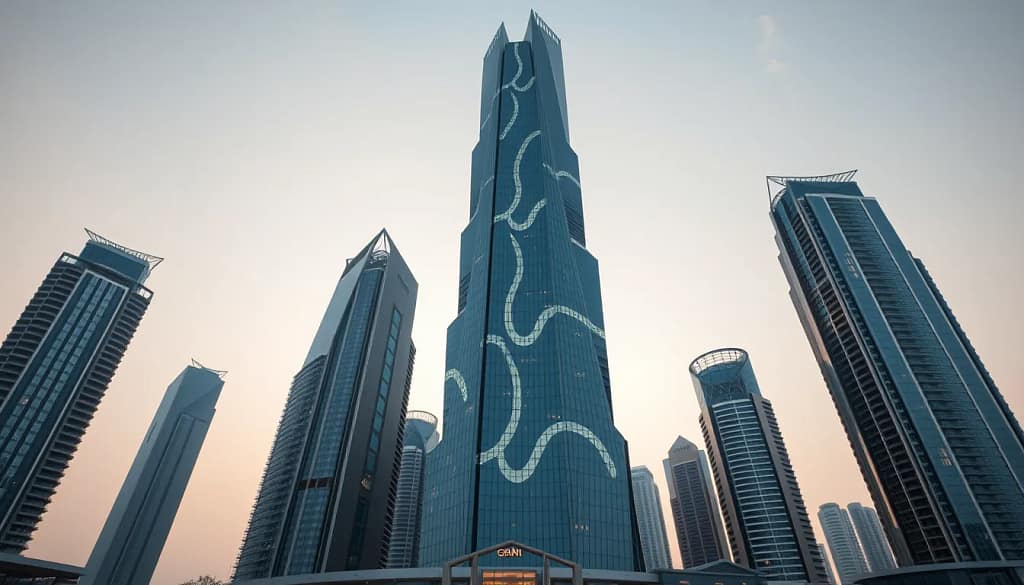
Une avancée majeure : l’impression 4D
Le secteur du bâtiment et de la construction aux Émirats Arabes Unis (EAU) connaît une révolution technologique avec l’intégration de l’impression 4D, une innovation qui promet de transformer la manière dont les projets sont conçus et réalisés. Alors que l’impression 3D est déjà bien intégrée dans de nombreux domaines, la 4D ajoute un aspect temporel, permettant aux matériaux de changer de forme et de fonction avec le temps.
Les principes de l’impression 4D
L’impression 4D va au-delà des techniques conventionnelles en incorporant des matériaux programmables qui réagissent aux stimuli comme la chaleur, l’humidité ou la lumière. Dans la construction, cela signifie des structures capables de s’adapter aux conditions climatiques locales, améliorant ainsi la durabilité et l’efficacité énergétique.
Exemples d’application
- Façades adaptatives : Les bâtiments peuvent ajuster leurs façades en fonction de la chaleur ou du vent, réduisant ainsi le besoin de climatisation.
- Infrastructure évolutive : Des ponts ou routes capables de s’auto-réparer ou de s’adapter à des conditions d’utilisation changeantes.
Impact sur le secteur aux Émirats
Les Émirats, connus pour leur architecture avant-gardiste, adoptent déjà ces innovations technologiques. Des projets pilotes sont en cours à Dubaï et Abou Dhabi, où plusieurs gratte-ciels utiliseront l’impression 4D pour des structures évolutives et écologiques.
En intégrant ces technologies, les Émirats continuent de se positionner en tant que leader mondial dans le secteur de la construction durable. Ces initiatives montrent la volonté du pays de réduire son empreinte carbone en urbain, un objectif en ligne avec les politiques de durabilité mises en place par le gouvernement.
Défis et perspectives
L’adoption large de l’impression 4D présente des défis, notamment en ce qui concerne le coût des matériaux et la formation des professionnels du secteur. Cependant, les avantages potentiels en termes d’efficacité et de protection environnementale incitent de plus en plus d’entreprises à investir dans cette technologie.
À long terme, l’impression 4D pourrait transformer le paysage urbain mondial, en rendant les constructions non seulement plus solides, mais aussi plus intelligentes et écologiques.
La course à l’innovation dans le secteur de la construction continue, et l’impression 4D est une étape significative vers l’avenir des bâtiments réactifs et adaptatifs.
Le succès des premières installations aux Émirats pourrait inspirer d’autres pays à adopter ce modèle innovant, propulsant encore plus loin les possibilités architecturales et constructives.
Conclusion
Avec l’exploration continue des capacités de l’impression 4D, la chaîne de valeur de la construction se renouvelle complètement, positionnant les Émirats en avant-garde dans cette transformation technologique internationale.
English version
4D Printing Revolutionizes Construction in the UAE
A Major Breakthrough: 4D Printing
The building and construction sector in the United Arab Emirates (UAE) is experiencing a technological revolution with the integration of 4D printing, an innovation that promises to transform how projects are designed and executed. While 3D printing is already well integrated in many fields, 4D adds a temporal aspect, allowing materials to change shape and function over time.
Principles of 4D Printing
4D printing goes beyond conventional techniques by incorporating programmable materials that respond to stimuli like heat, humidity, or light. In construction, this means structures capable of adapting to local climatic conditions, thereby improving durability and energy efficiency.
Application Examples
- Adaptive Facades: Buildings can adjust their facades based on heat or wind, thus reducing the need for air conditioning.
- Evolving Infrastructure: Bridges or roads capable of self-repairing or adapting to changing usage conditions.
Impact on the Sector in the UAE
The UAE, known for its avant-garde architecture, is already adopting these technological innovations. Pilot projects are underway in Dubai and Abu Dhabi, where several skyscrapers will use 4D printing for evolving and environmentally friendly structures.
By integrating these technologies, the UAE continues to position itself as a global leader in sustainable construction. These initiatives demonstrate the country’s commitment to reducing its urban carbon footprint, aligned with sustainability policies established by the government.
Challenges and Prospects
The widespread adoption of 4D printing presents challenges, particularly concerning material costs and the training of industry professionals. However, the potential benefits in terms of efficiency and environmental protection are driving more companies to invest in this technology.
In the long term, 4D printing could transform the global urban landscape, making constructions not only stronger but also smarter and more environmentally friendly.
The race for innovation in the construction sector continues, and 4D printing is a significant step towards the future of reactive and adaptive buildings.
The success of initial installations in the UAE might inspire other countries to adopt this innovative model, further pushing architectural and construction possibilities.
Conclusion
With the continued exploration of 4D printing capabilities, the construction value chain is being wholly renewed, positioning the UAE at the forefront of this international technological transformation.
Contactez-nous pour votre projet
Pour tous vos travaux professionnels de construction et de rénovation, faites appel à notre équipe : nous établissons un devis gratuit et personnalisé.
- 📞 Téléphone : 07 49 44 55 56
- ✉️ Email : contact@nikonov.fr
- 🌐 Site web : www.nikonov.fr
Contact us for your project
For all your professional construction and renovation works, contact our team for a free personalised quote.
- 📞 Phone: +33 7 49 44 55 56
- ✉️ Email: contact@nikonov.fr
- 🌐 Website: www.nikonov.fr